Atmospheric composition
Continuous monitoring of changes in atmospheric composition and urban air quality across Athens.
The Thissio Air Monitoring Station (Thissio AMS) has operated since 2013 at the central premises of the National Observatory of Athens.
Located in the historical centre of Athens on the Hill of Nymphs at 37.97°N, 23.72°E and 105 metres above sea level, the station overlooks the Attica basin from approximately 50 metres above the mean city level.
Its elevated urban-background location makes it an ideal observation point for studying aerosols and atmospheric pollutants originating from urban, regional and long-range transport sources.
Thissio AMS provides high-quality, high-resolution atmospheric measurements for scientific research, environmental services and near-real-time urban air-quality information.
Continuous monitoring of changes in atmospheric composition and urban air quality across Athens.
The station contributes to PANACEA, ACTRIS and greenhouse-gas monitoring activities associated with ICOS.
Measurements support research into aerosol health effects, climate, ecosystems and the deterioration of historic monuments.
Researchers investigate aerosol sources, chemical composition, physical properties and transport across the Eastern Mediterranean.
The station welcomes scientists, students and collaborating groups for specialist measurements and experimental campaigns.
High-resolution observations support researchers, public authorities, private organisations and citizens.
Thissio AMS operates as a hub for specialised atmospheric observations, instrument evaluation and targeted research campaigns.
Seasonal atmospheric measurement campaigns conducted during 2019–2020.
Monitoring of wintertime urban smog events in Athens since 2014.
Climate-relevant Cloud Condensation Nuclei measurements during 2017–2018.
Health-related aerosol oxidative potential monitoring since 2016.
Evaluation of the Magee Scientific automated Total Carbon analyser between 2019 and 2021.
Targeted airborne observations of wood-burning emissions during the ACTRIS JRA1 winter campaign.
Low- and medium-cost atmospheric sensors were evaluated and calibrated through intercomparison with reference instruments between 2019 and 2021.
The station is equipped with specialised online analysers for gaseous pollutants, particulate matter, aerosol properties, chemical composition and greenhouse gases.
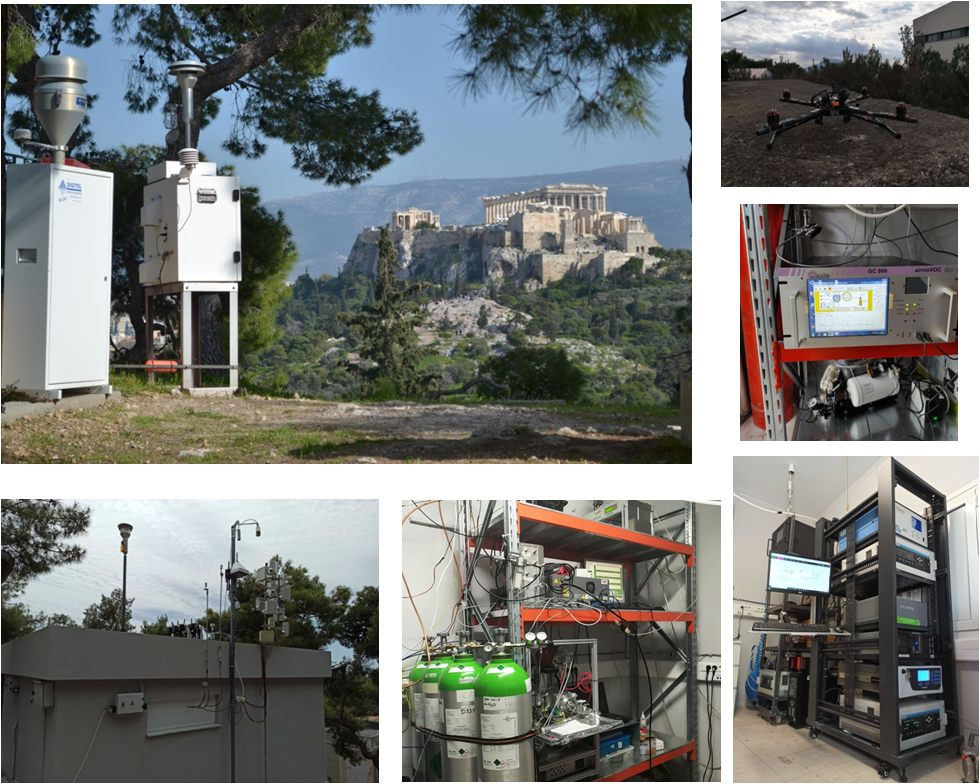
The station combines gas analysers, aerosol monitors, optical instruments, chemical-speciation systems and automatic sampling equipment.
| Pollutant or property | Equipment |
|---|---|
| Carbon monoxide CO | APMA-360 analyser, Horiba Ltd. |
| Nitrogen oxides NOx | Serinus 40, ACOEM Ecotech |
| Nitrogen oxides NOx | APNA-360 analyser, Horiba Ltd.** |
| Sulphur dioxide SO2* | APSA-360 analyser, Horiba Ltd. |
| Ozone O3 | 49-i analyser, Thermo Scientific |
| Greenhouse gases: CO2, CH4 and H2O | G2301 analyser, Picarro Inc. |
| Volatile organic compounds, BTEX and C6–C12 | GC 866 airmoVOC Auto GC-FID, AIRMOTEC AG |
| Particulate matter PM2.5 | 5014i beta-gauge monitor, Thermo Fisher Scientific |
| Particulate matter PM10** | FH 62 I-R beta-gauge monitor, Eberline |
| PM1, PM2.5 and PM10 | Model 11-D, Grimm Aerosol Technik |
| Black carbon and aerosol absorption | Seven-wavelength AE33 Aethalometer, Magee Scientific |
| Black carbon* | Model 5012 Multi-Angle Absorption Photometer, Thermo Scientific |
| Aerosol scattering | Model 3563 Integrating Nephelometer, TSI |
| Aerosol number-size distribution | Model 3034 Scanning Mobility Particle Sizer, TSI |
| Particle-number concentration | Model 3010 Condensation Particle Counter, TSI |
| Non-refractory submicron aerosol composition | Aerosol Chemical Speciation Monitor, Aerodyne Inc. |
| PM1 ionic composition** | PILS–Ion Chromatograph, Metrohm–Dionex |
| Sequential low-volume sampling: PM2.5 and PM2.5–10** | Model 2025 Dichotomous Partisol-Plus, Thermo Scientific |
| Sequential low-volume sampling: PM2.5 or PM10 | LVS 3.1–PNS 15 sampler, Derenda |
| High-volume PM2.5 sampling | Digitel DH-77 |
| Data acquisition | Congrego version 4.0.1, Ecotech |
* Equipment also used in the Mobile Air Quality Monitoring Station.
** Equipment used during past long-term measurements.
Fine-aerosol non-refractory chemical composition measurements include chloride, nitrate, sulphate, ammonium and organic compounds in PM1.
Additional laboratory analyses investigate ionic composition, elemental and organic carbon, trace and heavy metals, brown carbon, levoglucosan and other organic compounds, depending on current research priorities.
Results produced at Thissio AMS contribute to peer-reviewed publications, conference presentations, European research activities and improved understanding of atmospheric conditions across Athens and the Eastern Mediterranean.